Archive for May, 2010

On food and kitchens with three stoves


2010
05.17

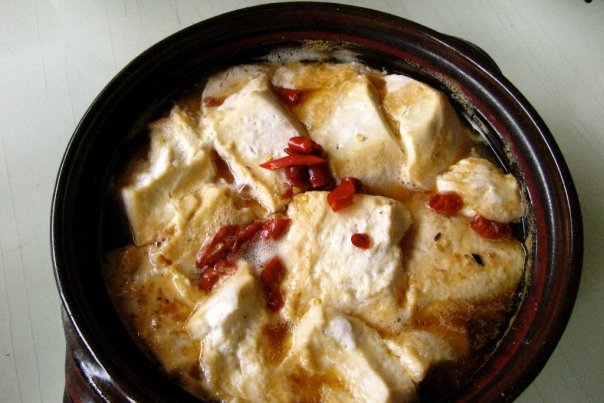
Home made tofu

We had gone to Qiandao Lake, about three hours by car from Shanghai, for a weekend of diving: at the bottom of the the lake was a thousand year old village that had been flooded back in the 1950s for a dam project.  When we arrived and suited up and threw ourselves overboard, we discovered that we wouldn’t be seeing much that weekend: because of silt that had been recently dredged by the local fishermen, visibility was nearly nil.  We did a few experimental dives but it was like swimming in vanilla pudding.

By noon on the Sunday, we were done.  Packed into a mini van driven by the dive guide, we tore down winding rural roads to a farm house somewhere deep in the hills.  While exploring the underwater city over the past few years, the dive team had made many connections in the area- essential when so far away from the nearest town. The farmers would prepare lunch for us.

The farm was forested, with chesnuts spread out on sheets to dry in small clearings, pigs housed in a wattle and daub barn, orange trees sprouting clusters of mandarins, potatoes growing up hillsides, and greens growing wherever they could.  The husband of the house was bent over at the waist, pulling up the fresh greens for our meal from a patch just behind the kitchen.  We sat at a table outside the kitchen house. It was a stand-alone  building with not much more than some haunches of hanging dried meat, piles of stored pumpkins, a spartan cooking area and a sink inside. A small irrigation stream ran past it.

The woman of the house chose some squash and chilis from the storage piles in the kitchen corner and slowly everything was methodically assembled and chopped and cooked on three different stoves (one gas,one coal, one wood). Endless dishes came streaming out of the wide open doorless kitchen.

I stalked the woman in the kitchen as she cooked, watching her chop and stir and move from stove to stove to stove. There was rice, home made spicy tofu, fatty pork, mildly sweet stewed pumpkin, several sleekly oiled greens, slivers of savoury courgette. She tried to explain to me, in words I have yet to learn, exactly what she was making and how.  I jokingly asked her to come cook for me in Shanghai for those days when I’m just too tired to do anything after work and she winked and said she couldn’t come this year but maybe next year.

When we left, we were told to take as many oranges as we wished. I took a few, but then the cook insisted I take more and more and grinned from ear to ear as she piled dozens of mandarins into my gear bag. I had an awful lot of oranges to eat.

(101 Things About Shanghai) Ludicrous Shopping Tactics


2010
05.16

Hello, you want buy crotchless bodysuit?

We went to the fakes market today in Nanjing Xi Lu, which is a 4-storey shopping mall that sells only bootlegged goods from hundreds of tiny shops the size of our kitchen. There are a lot of shirts and shoes and ties and small electronics and silk scarves and pashminas and, yes, yes, bags and watches.

Walking through it is much akin to making your way through the various circles of hell, with bony claw-like hands reaching out and grabbing you as you pass, and cackles and shrieks following you as you walk through the claustrophobic corridors. Unfortunately, if you have western-sized feet, it’s pretty much the only place in town where you can readily find anything affordable above a size 38 for women or 40 for men.  Since Doug lost his shoes somewhere in XingPing during our Yangshuo excursion/debacle, he needed to find himself another pair of non-work, non-sandal footwear. We missed his lost fake Timberlands.

We dreaded having to go back to the fakes market.  Bargaining starts at absurd prices, and if your Chinese is crappy (like ours is) it doesn’t readily go down to reasonable levels.  Case in point, while we were there today, I decided to get a cheap plastic cover for my iPod so it wouldn’t get scuffed.

Cheap and tawdry plastic cover

This is the sort of thing which would go for about 35 rmb in the Apple Store at Best Buy in Xujiahui. There are other, sturdier rubbery ones that go for about 100rmb but I didn’t need one of those. I wanted one that I’d find in a Vancouver dollar store.  There are quite a few shops in the fakes market that sell Mac crap, all fake, so I went around to a few and priced them and tested the negotiation waters.  I figured I was willing to pay 10rmb (about $1.50). The first woman started at 35 and went down to 20; the second also started at 35 then went down to 10 if I bought 2 of them (no, thank you); the third one started at 65, which I thought was hilarious. She went down immediately to 40, which was also hilarious. I did laugh. I laughed and I said I’d give her 10. She said okay. So now, as you can see, I have my iPod cover.  It’s pretty nifty.

We also got Doug’s shoes, the same ones as the ones he had left somewhere in rural Guangxi province two weeks ago.  Fake Timberland hiking shoes, with the initial asking price in the high 400 range.  It’s fascinating to see how high they’ll aim when they first start tapping prices into the omnipresent calculator. Starting at 480 then (oh, arm twist!) coming down to 450, then to 400 (oh, the pain! my children will starve!) then somehow, miraculously ending up at 180, which was what we had paid for them the first time, after half an hour of negotiating.  It was like they really did have a fixed price after all and the whole bargaining process was just for show.

Now that we have the shoes and the cover, I am not going to go back there anytime soon if I can help it.

How Not to Organize a Bike Tour in Rural China


2010
05.15

Leaving Yangshuo town

The road ended at the edge of a crumbling cliff, after a series of abrupt structural adjustments: what had been smooth asphalt turned to dusty asphalt, then to pot-holed concrete, then to broken concrete then to gravel then to rutted, dried mud.

It was when we hit the rutted dried mud that we found the cliff, and from the cliff’s edge we could see the bridge we were supposed to cross.

On our bicycle route map of Yangshuo County, this bridge was neatly drawn in, taking us from the long, un-intersected tertiary road that we had been following for several hours out of town, across the river, and meeting up with another tertiary road that would take us back to our lovely hotel in the countryside.  In reality, the bridge was only half built, stopping mid-way across the river.

We had a few options, all of them impractical, exhausting or absurd.

  1. We could carry our bikes down the crumbling cliff face onto the riverbanks and try to flag down a passing bamboo raft.
  2. We could turn around and cycle three hours back to the nearest crossroads.
  3. We could find a way up to the six lane toll-road that loomed high above the village we had just passed.  Cut into the reinforced embankment that rose up behind the tiny village,  we could see stone stairs leading up to a tunnel beneath the highway.

We asked two women and two small children sitting on stoops inside the village for directions in fractured Mandarin, in a lane narrow enough to reach your arms out and touch the wattle and daub walls on either side.  We hauled out our bicycle map and pointed to the last intersection we had passed  and pointed up to the highway roaring overhead and shrugged our shoulders and asked, ‘Where are we and how can we get out?’

The older woman shrugged and smiled. She was illiterate.

Along the ridgeway

The younger woman shrugged and pointed back to the distant  intersection we had passed three hours ago.  We pointed up to the highway and asked, ‘How can we get up there?

More shrugs.

We pointed down the narrow alleyway toward the highway and asked, ‘Can we get there from here?’

No, no, definitely not.

We looked at the highway embankment that rose up behind the village. We could push the bikes up there. Steep, to be sure, but not impossible. A three hour ride back to the intersection was daunting in the heat. My bare arms were pinkening already and our legs were tired from the hills. Yangshuo has many hills.

Through the grain tunnel. Henry Rivermonster vanished here.

We wheeled our bikes down the narrow lane to the back of the village, along a concrete ridge barely wide enough for a wheel and a foot to be placed side by side, hauling our bikes up the stairs at the end of the ridge to the tunnel beneath the elevated highway. The arched walls were lined with sheaves of grain.  The dark, grain-scented tunnel opened out onto a sudden and steep grassy hill rising up to a farmer’s field. Above us was the highway, the embankment blocked by barbed wire which was pulled back neatly.

(101 Things About Shanghai) Sudden Shops


2010
05.14

Sidewalk temporary fishmonger

In Canada, it is highly unlikely that you would ever come across a street vendor setting up an impromptu, unlicensed shop on the sidewalk. In fact, really, it’s unlikely you would ever come across a street vendor.

When they exist, they have been vetted and licensed and are usually selling hot dogs from a cart belonging to a nationwide chain of hot dog vendors.

In Shanghai, you can buy unexpected fresh fish from a bucket on the sidewalk if your timing is right.  There are also greengrocers set up on towels in driveways, selling their bok choy until their bok choy is gone.

From wooden carts, you can get mugs, plates and bowls (of the best quality melamine!), feather dusters, picture frames, bootlegged English novels, omelets, towels, cloth handkerchiefs.  You can get your knives sharpened or your keys cut, but only if you time it right.

They may or may not exist in an hour.

(101 Things About Shanghai) Casual Armband Security


2010
05.13

At the bus stop just outside our apartment complex there are three elderly people clad in matching orange wind breakers and baseball caps emblazoned with Shanghai Ping’an Volunteer (and a lot more in Chinese). They have government-issued red armbands pinned to their sleeves. They can also be found further up Shanxi Nan Lu, near the metro station. They mostly just sit on the bus benches and talk to each other for hours.

[Note: sorry for the crappy phone photos. I was trying to be inconspicuous]

Shanxi Nan Lu red guard imposter

I haven’t quite figured out if they are the descendants of the old skool neighbourhood watch grannies or if they are a new Expo gimmick.

In addition to the Elderly Windbreaker Watch, there are a lot more new security personnel roaming the city. This is not like Turkey where you have young men adorned with semi automatic weapons.  At the entrance to metro stations, the new red guard stand watch.  They smile though, and take smoke breaks with passers by.  They speak softly and carry small sticks.

In addition to these kind fellows,  we also have another guard supervising the outer entrance to the metro station. He mostly just plays games on his phone and smokes.

Ever so casual

Inside the metro stations they have set up very elaborate airport-style bag xray scanners, with posters advising passengers to obey the new security measures for the good of society. However, the guards supervising the scanners will readily let you bypass the conveyor belt if you indicate that you are in a hurry and quickly flash your bag flap open. Conveniently, I am in a rush every day.

I can’t say I miss stern boys with big guns.

(101 Things About Shanghai) Furthering the Mop Meme (Just Photos)


2010
05.12

Mop with Dried Fish

Just the Two of Mops

The 3 Mopsketeers

Mop Climbs Tree for Better View

(101 Things About Shanghai) New Wave Dogs


2010
05.12

Fur Real

One of the interesting things about living in a country that has only recently shifted from a practical, survivalist mode of living (hello Great Leap Forward!) is that everything bourgeois is new and exciting. This includes keeping pets as pets and not as, say, nutrition or security guards.

One big trend in Shanghai is to have a dog as a pet. This sounds quite simple and normal, but like taro root pies at McDonalds and mung bean scones at Starbucks, the concept of dogs has been interpreted by local yuppies in ever-so slightly unexpected ways.

For one, they decorate them. In our building, on the ground floor, there is a dog spa where dogs go (or rather, are carried, tenderly) to get their fur dyed rainbow colours.  This dog spa also sells dog clothes for all sizes. You can buy dresses, parkas, sweat suits, Converse sneakers, velvet high heels and sailor suits for your dog.

I have passed pairs of  dogs on leashes trotting down the street clad in identical silk cocktail dresses, tails dyed hot pink.

For those who don’t dress and dye their dogs, there is still the salon. While smaller dogs tend to be subjected to costuming and colouring, larger dogs are frequently burdened with big blow-dried ’80s hairdos.

Huge puffy-furred malamutes who somehow fit into tiny 37th floor apartments are regularly seen on their thrice a day exposure to the outdoors, pulling their tiny owner along by the leash to mark their territory amongst the fake rocks and fake ponds and mostly real foliage of our complex. Poodles are seen with marvellously picked ‘fros and collies have had their requisite hundred strokes with a hairbrush. Their fur smells nice.  I can’t help wondering how the dogs feel about all this.

Triptych of Cats in garden

On a more dignified note, cats seem to be left alone to do their own thing. They live independent lives, un-dyed, undressed, and have nice little bowls of kibble left out for them in parks and in building complexes and at the entrance to cracks in walls on the street which are known cat-homes.

Proof of Cat

(101 Things About Shanghai) Street Detailing


2010
05.11


Let's start with a broom

This morning as I walked to work, a Shanghai municipal worker was crouched down on her haunches, polishing a garbage bin. She had already carefully washed it down and was now rubbing shine into the metal containers with a suede cloth. It sparkled.  The garbage can sparkled.

Near her, another municipal worker was meticulously piecing together his own broom, using the branches from some bushes nearby that he had just trimmed.  The sidewalks of Shanxi Nan Lu were impeccable at 6:30am.

All traces of the previous day’s phlegm, snot, cigarette butts, baby poo and chicken bones were gone.  Leaves were swept up with the recycled-trimming broom.  It was shining.

And beans

The Hordes of Yangshuo


2010
05.04

Casual bamboo rafting on the river

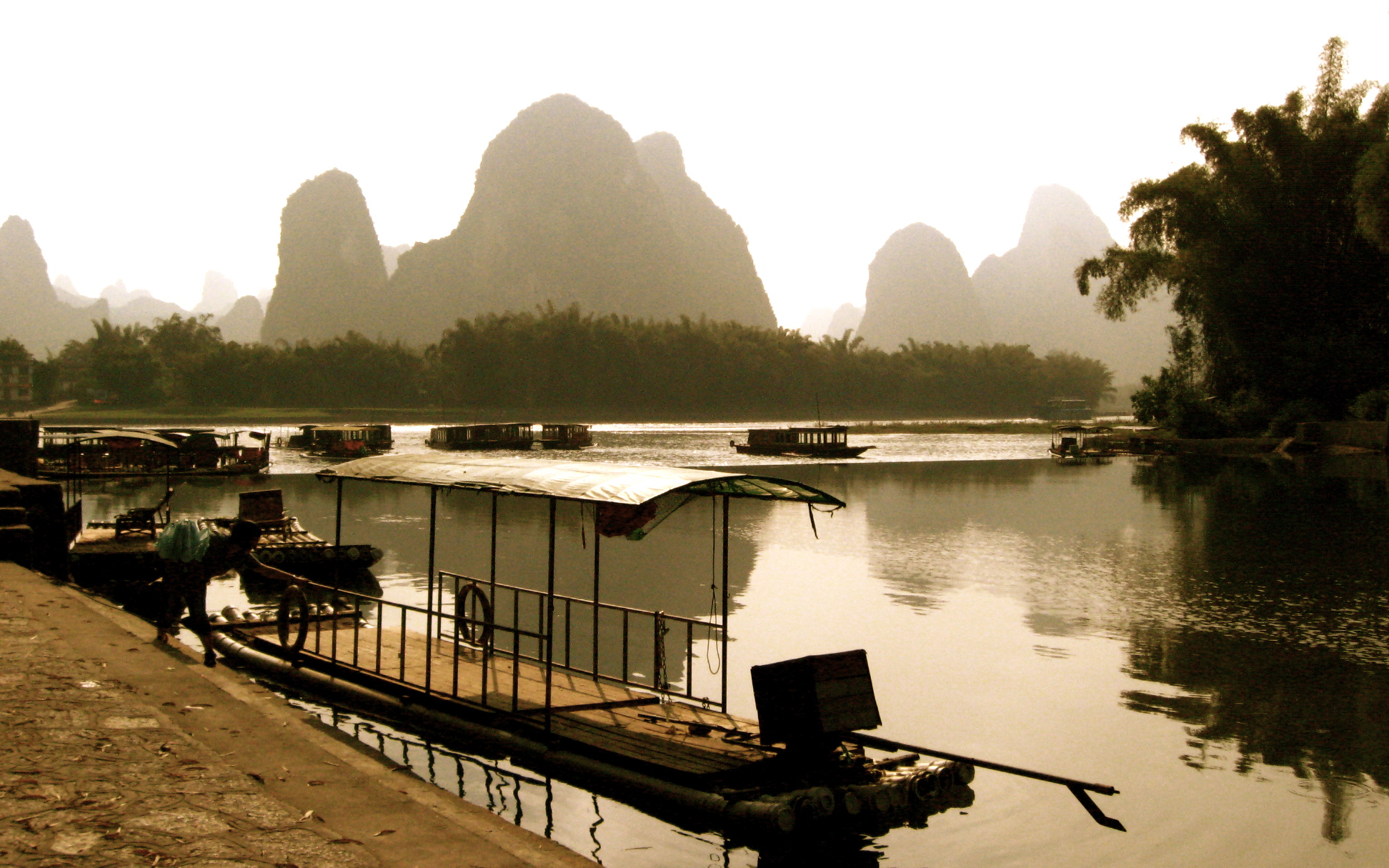
The hills are so famous that they are on the 20rmb note.  Looking closely at a 20rmb note, I failed to see the armies of uniformed tour groups and the clusters of hotels and the endless checkpoints of touts and vendors surrounding the hills. They are there. I know they are.  We walked amongst them every day we were in Yangshuo. At night, with the hills surrounding the town artfully illuminated by carefully placed spotlights, the walking streets of unsleepy Yangshuo were rippling with tourists.

I'm pretty sure I was here, because I have photographic evidence.

Want to pose with peacocks in leg manacles and chains? Sure! Want to hear an elderly instrument vendor scratching out the first few bars of Amazing Grace and Frere Jacques on his erhu? Can do! Want to be filmed by a dozen Chinese tourists who think it’s really interesting to see a foreigner in town? Oh yeah!  Don’t want to have to wait until evening or have to actually go out onto the river to get a picture of a fisherman or his cormorants? It’s okay, for a fee you can do it in town at noon.

Yangshuo is in theory a pretty little town. It has a lazy riverfront promenade that looks out onto the undeveloped opposite shore. There is a lone horse that tends to graze regularly there.  Lots of Karst hills in the distance. There’s a street market selling pretty things.  You can get silks, ginger candies, fruit, generic ethnic carvings,  more specific local ethnic carvings, a tshirt with your poorly drawn portrait on it, hippie flowery tops for women, absurdly cheap Tibetan silver (or rather, perhaps, ‘silver’), and cheap cotton mobile phone cases shaped like owls and fish.

The cormorant non-fisherman poses

There is a prominently placed Mc Donalds, illuminated at night by the spotlights meant for the arched bridge over the canal. There is a large KFC at the entrance to West Street, the main tourist walking street. There are quite a few KTV karaoke bars flashing their coloured lights further along the street. At night, you can barely move for all the people.

Women teeter in absurdly high spiked booties; men take pictures of them posing with the cormorants and manacled peacocks and assorted street statues.  Tour groups follow their baseball capped leaders with amplified headsets giving everyone within earshot an insight into their itinerary.

Xing Ping, home of bamboo river cruises

There are tourism agencies every 20 meters or so, selling visits to water caves (But not the fake ones like the others! Ours is the real one!), butterfly caves, ‘ethnic minority’ entertainment evenings, rice paddy day trips, white water rafting trips, bamboo raft river cruises. Between the agencies, individuals with laminated cards go from person to person, selling their bamboo raft cruises.  Restaurants with multilingual menus on pedestals out front are filled with backpackers and weekend tourists from big cities around China.  You can get banana pancakes. At least three places claim to have the Best Coffee, though none of them actually do.  There is an awful lot of wood-fired pizza available.

Pretty fields for cycling alongside

We didn’t stay in town. I would have been banging my head against the cobblestones had we chosen to go that route.  We chose a place about twenty minutes outside of Yangshuo, a place that had little personal balconies overlooking the countryside. Ours faced out onto a rice field and every morning we got to watch a farmer plough his field with his ox, shouting out the Chinese equivalent of Gee! Haw!  In the distance were the Karst mountains, rising up abruptly, green. Cicadas rattled. Birds sangs.

Gloom mongers posting on Trip Advisor had moaned about how isolated our hotel was, how difficult it was to get to and from the town (where all the excitement was!).  On our first day, we rented bicycles and cycled to town in half an hour. On other days, we used the hotel’s two free transfers to take us in to town and caught tuk-tuks and unmetered taxis back. Both quoted fares that were less than half what the posters had noted. Perhaps they were renting limousines. One never knows.

Outside of the town, it is lovely there. The people are lovely and the land is lovely. I’d simply bypass the town next time.

The hills are alive

Related Posts Plugin for WordPress, Blogger...

© 2011-2012 Mary Anne Oxendale / A Totally Impractical Guide to Living in Shanghai All Rights Reserved -- Copyright notice by Blog Copyright